

What buying schemes are available for new-build homes?
There are 5 key schemes available for people buying new-build homes in the UK, some are available to all purchasers, while others are specifically designed for first-time buyers.
In the market for purchasing a sparkling brand new home? There are lots of schemes that make homeownership more accessible
New Build Mortgages and Low Deposit Schemes
You won’t find new build mortgages and low deposit schemes in the resale market, which makes buying brand new all the more appealing.
For example, New Build Boost is aimed specifically at people buying new-build homes with a low deposit of 5%. Own New - Rate Reducer is a new build mortgages initiative designed to reduce monthly repayments.
There’s also Shared Ownership and First Homes, which give extra options to suit your personal circumstances. Let’s take a look at the different buying schemes available.
| Scheme | Who it's for | Minimum deposit | Key benefit |
|---|---|---|---|
| Own New Rate Reducer | All buyers | Not specified | Rates from sub-1% |
| Shared Ownership | All buyers | 5% of your share | Buy from 10% of property |
| New Build Boost | All buyers | 5% | 15% interest-free loan |
| First Homes | FTBs & key workers | Standard 5-10% | 30% to 50% discount |
| Lifetime ISA | FTBs aged 18-39 | N/A | 25% bonus up to £1k/year |
Own New - Rate Reducer
Own New - Rate Reducer is a buying scheme that offers lower mortgage rates for new-build home buyers. In some cases, even sub-1% rates could be available.
The scheme, launched by finance firm Own New, is open to people who buy a new-build home, whether they're a first-time buyer or an existing homeowner.
Rate Reducer works by effectively using housebuilders' budget for incentives to slash buyers’ monthly mortgage payments over a fixed term. For example, if a housebuilder offers a 5% discount on one of its new homes, Rate Reducer would take this sum and offset it against the mortgage interest.
Mortgage rates will depend on a variety of factors, such as the housebuilder’s incentives budget, the lender and the size of the buyer’s deposit
Say the housebuilder offers a 5% incentive and you take out a £350,000 mortgage on a 40-year term at 60% loan to value (LTV). The mortgage rate could drop from 4.79% to 0.99% over a 2-year term. That could mean monthly payments of £883 - a monthly saving of £756.
Multiple mortgage lenders, including Halifax and Virgin Money, brokers and more than 200 housebuilders are participating in the scheme.
Shared Ownership
Stepping onto the first rung of the property ladder may feel daunting – but Shared Ownership could give you a leg up and help you to own a home that may otherwise have been unaffordable.
With Shared Ownership, you only pay the deposit on - and need a mortgage for - the share of the property you're buying.
That means the amount of money you need for the deposit is a lot lower than it would be if you were buying the whole property outright.
The share you buy is usually between 25% and 75% of the total property, but with some homes, it can be as little as 10%.
You pay a mortgage on the share you own, and reduced rent on the portion you don’t own. That part is usually owned by a housing association, private developer or local authority.
As time goes on, you can increase your share in the property by buying more of it in increments, until you own all of it outright or are ready to sell it.
New Build Boost
New Build Boost launched in 2025. It aims to boost your borrowing power by providing an interest-free equity loan worth 15% of the home you're buying.
You only need a 5% deposit and with the loan topping you up, you'll be assessed against an 80% loan-to-value (LTV) criteria, which can give you access to better mortgage rates.
The scheme is open to both first-time buyers and existing homeowners buying a new-build. New Build Boost is running at all Persimmon and Charles Church developments, as well as at a wide selection of Lovell Homes sites.
What's more, the equity loan is interest-free for the whole mortgage term duration and its value is fixed for the first 5 years. After that, it adjusts in line with the market value, capping the repayments at twice the original loan amount.
In a nutshell, New Build Boost means you need to save less for a deposit but you get access to a decent mortgage rate thanks to the equity loan top-up.
First Homes
The First Homes scheme launched in 2021 to help local first-time buyers and key workers onto the property ladder. It offers new-build homes at a 30% - 50% discount.
The reduced rates will apply to the homes forever, meaning that buyers on a low income will continue to benefit every time the property is sold.
The government has pledged a further 10,000 properties will be added to the First Homes scheme every year.
To qualify for the First Homes discount, buyers need to meet certain criteria:
-
You must be a first time buyer. That means that anyone who has ever inherited or been gifted a home is ineligible.
-
You must earn less than £80,000 (or £90,000 in London), whether you're buying solo or as part of a couple.
-
The property you’re buying must cost no more than £250,000, or £420,000 in London.
-
You must already work or live in the area you’re wanting to buy in, or have a connection to it. Say you grew up there or have family there, for example.
-
Key workers will be prioritised.
Lifetime ISA
The Lifetime ISA is open to buyers of any type of property.
A Lifetime ISA is an ISA with benefits. You can save up to £4,000 a year with one and the government will chip in an extra 25% on top. That’s up to £1,000 per year for free.
If you're worried about how you're ever going to save up enough to buy a place, a Lifetime ISA could earn you thousands of free cash for your first home.
Lifetime ISAs can be used by anyone saving up for their first pad - or for retirement. You can open one up if you’re between 18-39 and you can keep stashing cash away in it until you’re 50.
You earn tax-free interest on whatever you save and what the government contributes, which in turn earns interest the next year. That’s called compound interest.
The government has announced it will close Lifetime ISAs to new applicants some time in 2028, probably April. If you already have a Lifetime ISA or open one before the scheme closes, it will continue as is when the scheme closes.
A new way to save for a deposit – the First-Time Buyer ISA – will take over when Lifetime ISAs end. There won’t be an age cap on opening or paying into a First-Time Buyer ISA, and there will be no withdrawal penalties.
Developer incentives
In addition to all of these buying schemes, many housing developers will also offer incentives to help buyers to secure a new-build home.
They can include:
-
Paying the buyer's stamp duty
-
Making a financial contribution towards a deposit
-
Paying the buyer's legal fees
-
Paying the rent on a Shared Ownership property for a period of time
-
Free soft furnishings packages, including blinds and curtains
-
Free upgrades on flooring and appliances
-
Offering free family travel cards in the area
Each developer will have their own range of offers available, so it's worth checking in with them when viewing new properties.
Deposit Unlock
Deposit Unlock was a scheme run by the house-building industry that enabled people to buy a new-build home with just a 5% deposit. The scheme closed to new applicants in April 2026, but your lender will still honour the scheme if your mortgage offer is outstanding.
Help to Build
The Help to Build Equity Loan Scheme ended in March 2025. It was a government initiative designed to financially support self-builders who wanted to create their own homes.
Key takeaways
- There are currently 5 main schemes supporting new-build purchases in the UK: Own New – Rate Reducer, Shared Ownership, New Build Boost, First Homes and the Lifetime ISA. Each scheme is designed for different types of buyers and financial circumstances.
- Own New – Rate Reducer can reduce mortgage rates to below 1% for an initial fixed period by using incentives offered by the house builder to help cover mortgage interest. The scheme is available to existing homeowners as well as first-time buyers.
- Shared Ownership allows buyers to purchase a percentage of a property — usually between 25% and 75%, although some properties allow an initial share of just 10%. Buyers pay a mortgage on the portion they own and rent on the remaining share, with the opportunity to purchase additional shares later.
- First Homes provides eligible first-time buyers and key workers with discounts of between 30% and 50% on selected new-build properties. Applicants must generally have an income below £80,000 (£90,000 in London), while the property price is capped at £250,000 (£420,000 in London).

Can You Exchange Contracts and Complete on the Same Day?
Exchange and completion are usually separated by several days or weeks, but they can happen on the same day. The key is careful preparation, good communication and making sure every party is ready to proceed.
Key Points
- Exchange and completion are separate stages of a property transaction.
- Many buyers and sellers leave around one to four weeks between the two stages.
- There is no requirement for a lengthy gap, so exchange and completion can take place on the same working day.
- Same-day completion can make a transaction quicker and remove the uncertainty that normally exists between exchange and moving day.
- However, it leaves very little room for delays, problems with mortgage funds or last-minute changes.
- Buyers using a mortgage should check the proposed arrangement with their solicitor and lender well in advance.
Is Same-Day Exchange and Completion Possible?
Yes. In England and Wales, it is possible to exchange contracts and complete the property transaction on the same day.
It is not the usual arrangement for every sale, but it can work particularly well where the transaction is straightforward and everyone involved is properly prepared.
The important point is that exchange and completion remain two separate legal stages, even when they happen only a few hours apart.
Before exchange, the buyer or seller may generally still decide not to proceed, although they may already have incurred professional or other costs.
Once contracts have been exchanged, however, the agreement becomes legally binding.
Completion then follows when the purchase money is transferred and ownership of the property passes to the buyer.
What Is the Difference Between Exchange and Completion?
Understanding these two stages makes it easier to see how they can take place on the same day.
Exchange of Contracts
Before exchange, the buyer's and seller's solicitors or conveyancers will work through the legal details of the transaction.
This normally includes matters such as:
- searches and enquiries
- the agreed purchase price
- fixtures and fittings
- mortgage arrangements
- the property's legal title
- the completion date
- any conditions attached to the sale.
Once both sides are satisfied and have authority from their clients, contracts are exchanged.
At this point, the agreement becomes legally binding.
A deposit is also commonly dealt with at exchange. A traditional contractual deposit is often 10% of the purchase price, although the actual amount and the way it is handled can vary depending on the transaction.
Completion
Completion is the point at which the sale is finalised.
The buyer's solicitor sends the required completion funds to the seller's solicitor. Once the money has been received and completion has taken place, the buyer can normally collect the keys from the estate agent or as otherwise agreed.
For the seller, their solicitor will usually deal with matters such as repaying any existing mortgage and settling relevant fees before transferring the remaining sale proceeds.
So, on a same-day transaction, exchange may happen earlier in the day, followed by completion once the required funds and legal arrangements are in place.
How Long Is There Normally Between Exchange and Completion?
There is no single compulsory period that applies to every property transaction.
In many cases, buyers and sellers agree a gap of approximately 7 to 28 days between exchange and completion.
This gives both sides time to organise the practical side of moving, including:
- removals
- buildings and contents insurance
- utilities
- change of address arrangements
- time off work
- handing over or collecting keys.
However, the completion date is something that is agreed as part of the transaction.
If everyone is ready, exchange and completion can potentially happen within the same day.
Why Would Someone Choose Same-Day Exchange and Completion?
There are several reasons why buyers and sellers may prefer to minimise the gap.
1. A Faster Property Transaction
The obvious benefit is speed.
Instead of exchanging and then waiting another week or two for completion, the transaction can move from legal commitment to completion on the same day.
For buyers who are ready to move and sellers who want the transaction concluded quickly, this can be attractive.
2. Less Time for Problems to Develop After Exchange
When there is a gap between exchange and completion, unexpected events can occasionally create difficulties.
A same-day arrangement removes most of that waiting period.
3. Useful for Certain Investment Transactions
Same-day exchange and completion may be particularly practical for some buy-to-let transactions, especially where tenants are remaining in the property and neither party needs to coordinate a physical move on completion day.
4. Suitable for Vacant Properties
If the property is already empty, there may be fewer moving arrangements to coordinate.
That can make a quick completion easier to manage.
5. Helpful for Chain-Free Transactions
A cash buyer or a buyer who does not need to sell another home first may have fewer dependencies.
Transactions involving no property chain can therefore sometimes be easier to organise for same-day exchange and completion.
What Are the Risks?
Speed can be useful, but same-day exchange and completion also reduces the margin for error.
There Is Less Certainty Before Exchange
Until exchange has actually taken place, the transaction is generally not contractually binding.
If someone changes their mind shortly before the planned exchange, the transaction may not proceed.
This can be particularly inconvenient if removals, time off work and other arrangements have already been booked on the assumption that completion will happen.
Mortgage Funds May Cause Delays
A buyer using a mortgage needs to be especially careful.
Mortgage lenders have their own requirements for releasing funds, certificates of title and completion arrangements.
A buyer should therefore not assume that mortgage money can simply be requested and received at short notice.
The solicitor or conveyancer should check the lender's requirements well before the proposed completion date.
Very Little Time to Solve Problems
With a traditional gap between exchange and completion, there is some time to resolve practical issues.
With a same-day transaction, a banking delay, missing document, unresolved enquiry or problem elsewhere in the chain could disrupt the entire day's plans.
Moving Arrangements Can Become Riskier
If a removal company has been booked and the transaction does not exchange as expected, changing or cancelling the booking at short notice could result in additional costs.
Anyone choosing same-day exchange and completion should therefore understand that practical arrangements made before exchange carry some risk.
Property Chains Make Things More Complicated
Same-day transactions become harder when several buyers and sellers are linked together.
Funds may have to move through several solicitors' client accounts before each transaction in the chain can complete.
Even a relatively small delay near the beginning of the chain can affect everyone else.
Which Property Transactions Are Best Suited to Same-Day Exchange and Completion?
There is no universal rule, but it can be easier to arrange where the transaction is relatively simple.
Examples may include:
- vacant properties, where nobody needs to move out before completion
- buy-to-let purchases with tenants remaining in place
- cash purchases, where there is no mortgage lender involved
- chain-free purchases or sales
- straightforward transactions with no outstanding legal issues
- transactions where all funds and signed documents are already available.
A complicated property chain, unresolved enquiries or mortgage conditions can make a same-day arrangement considerably more difficult.
How Can Buyers and Sellers Prepare?
Preparation is particularly important when there is no gap between exchange and completion.
Choose an Efficient Solicitor or Conveyancer
Good communication is essential.
Your legal representative needs to know that same-day exchange and completion is being considered so they can identify any potential problems early.
Complete Paperwork Quickly
Return requested documents, identification checks and signed paperwork promptly.
Outstanding documentation can prevent your solicitor from being ready to exchange.
Resolve Searches and Enquiries
The buyer should normally be satisfied with searches, surveys and legal enquiries before authorising exchange.
Trying to resolve significant outstanding matters on the intended completion morning is rarely ideal.
Have Funds Available
Any deposit, balance of purchase money and associated funds that the buyer must provide should be available according to the solicitor's instructions.
Bank transfer limits should also be checked in advance.
Confirm Mortgage Arrangements
If a mortgage is involved, make sure the formal mortgage offer is in place and ask your conveyancer whether the lender's requirements are compatible with the proposed timetable.
Keep Everyone Informed
The buyer, seller, estate agent, solicitors, mortgage lender where applicable and anyone involved in a property chain should understand the intended timetable.
Clear communication can prevent small misunderstandings becoming major delays.
Frequently Asked Questions
Is the completion date agreed before contracts are exchanged?
Yes. The completion date is normally agreed between the parties and confirmed as part of the exchange process.
The most suitable date can depend on factors such as the property chain, work commitments, tenancy dates, school arrangements and the availability of mortgage funds.
With simultaneous exchange and completion, that agreed completion date is simply the same day as exchange.
Can I exchange and complete on the same day if I have a mortgage?
Potentially, yes.
However, your lender's requirements must be checked in advance.
Mortgage lenders can have different procedures and notice requirements for releasing the mortgage advance. Your solicitor or conveyancer should confirm that the necessary funds can be available in time before planning a same-day transaction.
Can somebody pull out on the morning of exchange?
Before contracts have actually been exchanged, either side may generally decide not to continue with the transaction.
This is one of the main risks of making expensive moving arrangements before a same-day exchange has taken place.
What happens if someone pulls out after exchange?
The position changes significantly once contracts have been exchanged because the agreement is then legally binding.
Failing to complete after exchange can amount to a breach of contract and may have serious financial and legal consequences.
Depending on the circumstances and the terms of the contract, these could include claims relating to the deposit, interest, losses or other remedies.
Anyone facing this situation should obtain advice from their solicitor immediately.
Is the deposit always 10%?
Not necessarily.
A 10% contractual deposit is traditional in many transactions, but a different amount may be agreed or dealt with differently, particularly within a property chain.
Your solicitor will explain exactly what is required for your transaction.
Does completion have to happen on a Friday?
No.
Property transactions can complete on other working days.
Friday remains popular because many people prefer to have the weekend available for unpacking and settling into their new home.
However, completing earlier in the working week can sometimes provide more time to deal with banks, solicitors or other professionals if an unexpected issue occurs.
Is Same-Day Exchange and Completion Right for You?
Exchanging contracts and completing on the same day can be an effective way to speed up a property transaction, but it requires more preparation than simply choosing an earlier moving date.
The legal work should be complete, funds need to be ready, mortgage requirements must be satisfied and everyone involved needs to understand the timetable.
It can be particularly effective for straightforward, vacant, chain-free or investment property transactions. For buyers and sellers involved in a complicated chain, the additional uncertainty may make a more traditional gap between exchange and completion more practical.
Before agreeing to simultaneous exchange and completion, speak to your solicitor or licensed conveyancer. They can review your individual transaction, check any lender requirements and advise whether the proposed timetable is realistic.
Disclaimer: This article provides general information about property transactions in England and Wales and should not be treated as legal, financial or mortgage advice. Individual circumstances and lender requirements vary. Always obtain advice from an appropriately qualified professional before making decisions about a property transaction.

Bank of England Holds Base Rate at 3.75%: What It Means for Mortgages and the Property Market
The Bank of England has kept the UK Bank Rate unchanged at 3.75% following its latest monetary policy decision, announced on 30 July 2026. With inflation easing to 2.6% in June, the decision offers a period of stability for borrowers, although uncertainty around energy costs and the wider economy continues to influence the outlook.
Key points at a glance
- The Bank of England has maintained the Bank Rate at 3.75%.
- Six members of the Monetary Policy Committee voted to keep rates unchanged, while three preferred an increase to 4%.
- UK CPI inflation eased to 2.6% in June 2026, compared with 2.8% in May.
- Tracker mortgage customers are unlikely to see a direct change in repayments as a result of the July decision.
- Fixed mortgage pricing may still move because lenders also respond to financial markets and expectations about future interest rates.
- The next Bank of England monetary policy announcement is scheduled for 16 September 2026.
Why has the Bank of England kept interest rates unchanged?
Interest rates are one of the main tools used by the Bank of England to keep inflation under control.
At its meeting ending on 29 July, the Monetary Policy Committee voted 6–3 to maintain Bank Rate at 3.75%. The three members who voted against the decision preferred an increase of 0.25 percentage points to 4%.
The decision reflects a balance between improving domestic inflation data and continuing risks to prices.
Inflation has been moving closer to the Bank's long-term 2% target. However, energy markets have remained uncertain, with higher and more volatile oil and energy prices creating the possibility of renewed inflationary pressure.
Rather than changing rates immediately, the Bank has therefore chosen to keep borrowing conditions steady while assessing how these pressures develop.
Inflation has continued to ease
The latest inflation information available when the Bank made its July decision showed further improvement.
According to the Office for National Statistics, UK CPI inflation fell to 2.6% in June 2026, from 2.8% in May.
Recent CPI figures show the direction more clearly:
- March 2026: 3.3%
- April 2026: 2.8%
- May 2026: 2.8%
- June 2026: 2.6%
This represents meaningful progress towards the Bank of England's 2% inflation target, although policymakers remain alert to the possibility that external factors, particularly energy prices, could interrupt that trend.
What could happen to UK interest rates next?
The decision to leave Bank Rate at 3.75% does not necessarily mean rates will stay at this level for the rest of the year.
Future decisions will depend on several factors, including inflation, wage pressures, economic activity and developments in global energy markets.
If inflation continues moving sustainably towards the 2% target and economic conditions weaken, this could create greater scope for lower rates in the future. On the other hand, renewed inflationary pressure could encourage the Bank to keep rates higher for longer or reconsider an increase.
The Bank's next scheduled monetary policy announcement is 16 September 2026.
What does a 3.75% Bank Rate mean for mortgage borrowers?
The impact depends largely on the type of mortgage you have.
Tracker mortgages
Tracker mortgage rates normally follow the Bank Rate, usually with an additional percentage margin set by the lender.
Because Bank Rate has remained at 3.75%, borrowers on tracker products should not normally see their rate change purely because of the July decision.
Fixed-rate mortgages
Fixed mortgage rates work differently.
They are influenced not only by the current Bank Rate but also by wholesale funding costs, financial market expectations and lenders' own pricing strategies.
This means fixed mortgage deals can move even when the Bank of England leaves its official rate unchanged.
Homeowners approaching the end of a fixed deal may therefore benefit from reviewing the market before their existing mortgage expires rather than assuming that today's Bank Rate determines the deal they will receive.
Buyers planning a purchase
For prospective buyers, mortgage affordability remains an important part of deciding what price range is realistic.
Knowing your likely deposit, monthly repayment and available mortgage options before making an offer can provide a much clearer picture of what you can comfortably afford.
Independent mortgage advice may also be useful where circumstances or borrowing requirements are more complex.
What could this mean for the UK property market?
A period of stable interest rates can provide buyers and homeowners with greater certainty when budgeting for a move or refinancing.
However, the Bank Rate is only one part of the property market.
Mortgage pricing, household income, the number of homes available for sale, buyer confidence and local supply and demand all play a role in determining activity and property values.
For buyers, improved choice in some areas may create opportunities to compare properties carefully and negotiate where appropriate.
For sellers, realistic pricing remains particularly important. Homes positioned correctly for their local market are generally better placed to attract serious buyers than properties launched at an overly ambitious asking price.
Landlords and property investors should also consider financing costs when reviewing rental yields, refinancing plans or future acquisitions.
Is now a good time to buy or sell?
There is no single answer that applies to every homeowner or buyer.
A stable Bank Rate removes one immediate source of uncertainty, but individual property decisions should still be based on personal finances, mortgage affordability and conditions in the local housing market.
If you're considering selling, understanding the current value of your home is a useful starting point.
If you're planning to buy, reviewing your borrowing position before beginning your property search can help you focus on homes that genuinely fit your budget.
Looking ahead
The Bank of England's July decision provides some short-term stability, with Bank Rate remaining at 3.75%.
Inflation has moved considerably closer to target, but policymakers are still watching energy prices and wider economic conditions carefully.
For buyers, sellers, landlords and homeowners looking to remortgage, the coming months will be worth watching closely. Mortgage products may continue to change even without an immediate movement in Bank Rate, making up-to-date financial and local property advice particularly valuable.
Information in this article is provided for general guidance and does not constitute financial or mortgage advice.
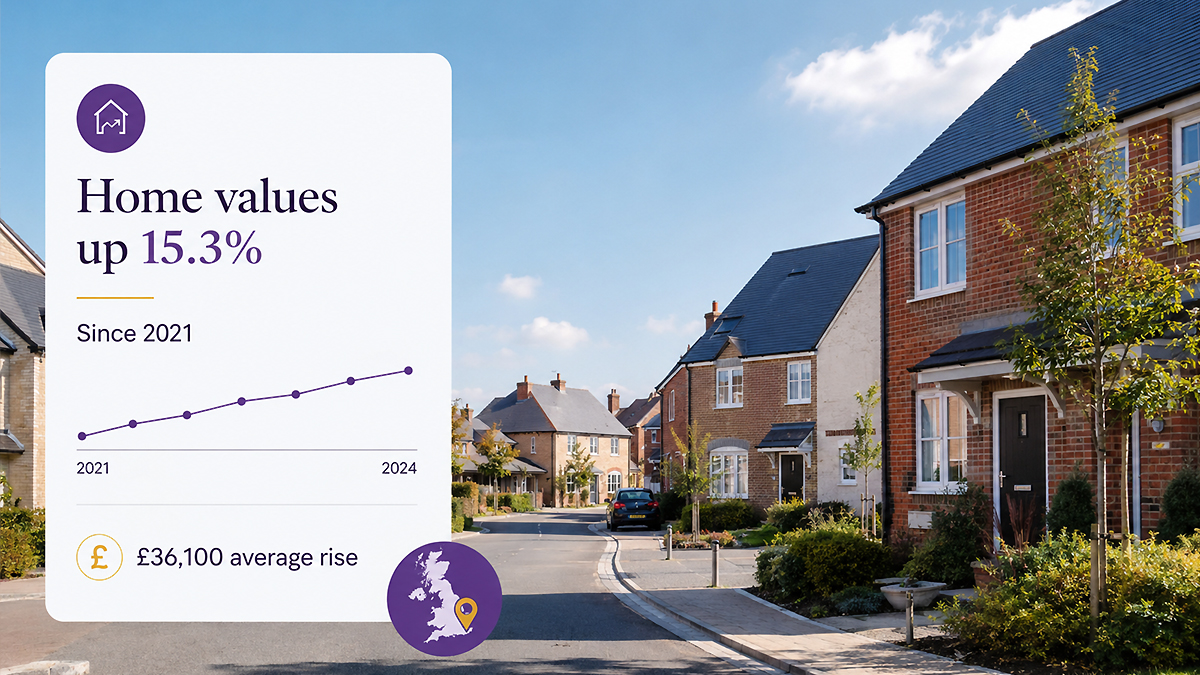
UK Home Values Have Grown by an Average of 15.3% Since 2021
Homeowners who bought or already owned a property in 2021 may now be sitting on a noticeably more valuable asset. On average, UK homes have gained around £36,100 in value over the period — but the level of growth varies considerably depending on where you live.
The average cost of a UK home increased by 15.3% between June 2021 and June 2026, representing an average gain in value of approximately £36,100. Historically, house prices have risen in 25 of the last 30 years. However, the move away from the era of exceptionally low mortgage rates has changed the way property values are behaving across different parts of the country.
Mortgage Rates Are Affecting Different Parts of the UK Differently
Borrowing conditions have changed significantly over the past five years. At the beginning of 2021, some mortgage rates were available from as little as 0.79%. Since then, borrowing costs have risen substantially, with average mortgage rates reaching around 4% to 5%. Higher borrowing costs have reduced affordability for many buyers and influenced the pace at which property values have increased. The impact has generally been more noticeable in regions where average house prices are already high. By contrast, buyers in locations where property values remained around or below the UK average house price of £271,900 have often been better positioned to absorb higher mortgage costs. That relative affordability has helped maintain buyer activity in many of these areas. Where demand remains strong, property values have had a greater chance of continuing to rise.
Homeowners in the North Have More Reasons to Celebrate
Northern regions have recorded some of the strongest levels of consistent property value growth during the past five years. The North West is particularly notable, with 29.7% of homes increasing in value during every single year of the five-year period. It was followed by Scotland at 22.6%, Yorkshire & The Humber at 22%, the North East at 20.5%, and Wales at 19.1%. These figures are considerably stronger than the levels of continuous growth recorded across many southern regions.
| Region / Country | Homes That Increased in Value Every Year | % of Homes Increasing Over 5 Years | Homes That Fell in Value Every Year | % of Homes Decreasing Over 5 Years |
|---|---|---|---|---|
| Northern Ireland | 300,400 | 37.9% | 0 | 0.0% |
| North West | 1,006,800 | 29.7% | 700 | 0.0% |
| Scotland | 599,200 | 22.6% | 9,300 | 0.3% |
| Yorkshire & The Humber | 551,200 | 22.0% | 1,500 | 0.1% |
| North East | 250,800 | 20.5% | 600 | 0.0% |
| Wales | 277,900 | 19.1% | 300 | 0.0% |
A Different Picture Across the Midlands
The last five years have produced noticeably different results depending on whether a home is located in the East or West Midlands. In the West Midlands, more than half a million properties — equivalent to 19.6% of homes — increased in value during every year between 2021 and 2026. The picture was quite different in the East Midlands, where only 9.8% of homes achieved consecutive annual increases in value.
| Region / Country | Homes That Increased in Value Every Year | % of Homes Increasing Over 5 Years | Homes That Fell in Value Every Year | % of Homes Decreasing Over 5 Years |
|---|---|---|---|---|
| West Midlands | 502,400 | 19.6% | 1,900 | 0.1% |
| East Midlands | 212,400 | 9.8% | 800 | 0.0% |
Southern England Has Seen Less Consistent Growth
Higher property prices and tighter mortgage affordability have made continuous year-on-year growth much less common across southern England. Where house prices already begin from a substantially higher level, increases in mortgage costs can place considerably more pressure on buyers' budgets. As a result, only around 1 in 20 homes in Southern England increased in value in every year from 2021. For homeowners in London, the South West, South East and East of England, fewer than 5% of properties recorded a value increase during every one of the five years.
| Region / Country | Homes That Increased in Value Every Year | % of Homes Increasing Over 5 Years | Homes That Fell in Value Every Year | % of Homes Decreasing Over 5 Years |
|---|---|---|---|---|
| London | 178,000 | 4.6% | 30,400 | 0.8% |
| South West | 107,300 | 4.1% | 1,300 | 0.0% |
| South East | 129,400 | 3.2% | 6,100 | 0.2% |
| East of England | 72,600 | 2.6% | 3,700 | 0.1% |
Which Local Areas Have Seen the Most Resilient Growth?
Looking beyond regional averages reveals some interesting local property markets that have performed very differently from the wider national picture. Several towns have recorded an unusually high proportion of homes increasing in value during every year of the five-year period.
| Post Town | Region | Homes Recording Consistent Price Growth Over 5 Years | % of Homes Increasing in Value Each Year |
|---|---|---|---|
| Bonnybridge | Scotland | 3,660 | 60.8% |
| Antrim | Northern Ireland | 10,583 | 60.5% |
| Castleford | Yorkshire & The Humber | 13,395 | 53.6% |
| Wednesbury | West Midlands | 10,940 | 51.3% |
| Dukinfield | North West | 4,817 | 51.1% |
| Tonypandy | Wales | 4,636 | 46.6% |
| Hebburn | North East | 4,881 | 42.6% |
| Hope Valley | East Midlands | 2,019 | 37.5% |
| Dagenham | London | 15,800 | 31.6% |
| Bicester | South East | 7,408 | 27.7% |
| Dursley | South West | 1,387 | 15.1% |
| Witham | East of England | 2,208 | 13.3% |
Dagenham Stands Out Within London
Dagenham provides a particularly interesting example of how affordability can support property values. Homes in this part of East London cost around 25% less than the London average, with a typical price of approximately £400,000 compared with £525,000 across the capital. Despite improvements to transport connections and the wider appeal of East London, Dagenham has remained one of the more affordable parts of the capital. Transport improvements, including the Elizabeth Line and the London Overground extension to Barking Riverside, have also helped strengthen the area's connectivity. The combination of relatively accessible property prices and good transport links appears to have supported Dagenham's resilience. Around 31.6% of homes in Dagenham increased in value during every year since 2021, compared with just 4.6% across London as a whole.
Hebburn Also Shows Strong Resilience
Hebburn in the North East provides another example of a comparatively affordable market recording consistent growth. More than 42% of homeowners in the town saw their property's value increase during each of the past five years. The town benefits from access to the Tyne & Wear Metro, while its average sold property price of approximately £168,146 keeps housing relatively affordable compared with many other parts of the UK.
Bonnybridge Leads the Way
The strongest example of consistent five-year value growth can be found further north in Scotland. In Bonnybridge, an impressive 60.8% of homes increased in value during every year since 2021. The village combines two characteristics that appear repeatedly among resilient property markets: comparatively affordable housing and strong transport connections. The average property price is around £220,000, while both Glasgow and Edinburgh can be reached in less than an hour.
Good Transport Links Alone Do Not Guarantee Growth
Witham in the East of England provides a useful reminder that strong commuter links do not automatically result in consistent property value increases. Despite being the strongest-performing location in its region over the five-year period, only 13.3% of homes in Witham increased in value during every year. The town offers a journey of approximately 45 minutes to London Liverpool Street, giving commuters relatively straightforward access to the capital. However, its average property value of around £320,000 is considerably higher than in some of the country's more resilient locations. This suggests that affordability remains important. When property prices are already close to the upper end of what local buyers can comfortably afford, values may find it harder to increase consistently — even when transport connections are excellent.
## Understanding What Your Home Could Be Worth
Every property market is different. National figures can provide a useful overall picture, but conditions vary considerably between regions, towns, neighbourhoods and even individual postcodes. Keeping track of your property's estimated market value can help you make better-informed decisions if you are considering moving home. For example, understanding the current value of your property can help you:
- Estimate the equity in your existing home**, giving you a clearer idea of the budget available for your next move.
- Set a more realistic asking price** if you decide to sell, potentially reducing the likelihood of having to make price reductions later.
- Understand conditions in the area where you want to buy**, including whether values have remained resilient or have recently fallen.
- Strengthen your negotiating position** when buying in a market where property values have softened.
How Much Has Your Property Changed in Value?
The national property market has changed significantly since 2021, but headline figures only tell part of the story. While the average UK home has increased in value by 15.3%, individual homeowners may have experienced considerably higher or lower growth depending on their location, property type and local market conditions. If you are thinking about selling, letting, remortgaging or simply want to understand your current position, obtaining an up-to-date property valuation can provide a much clearer picture of what your home may be worth today.
Key Takeaways
- The typical UK home has gained approximately £36,100 in value since 2021, representing an average increase of around 15.3%.
- Homes in several northern parts of the UK have shown particularly consistent growth, with a higher proportion of properties recording value increases year after year.
- Long-term property values have historically tended to rise, with UK house prices increasing in 25 of the past 30 years. However, homeowners should not assume that property prices will increase every single year.

5 Standout London Events for Landlords This August 2026
London’s calendar is part of what makes every neighbourhood distinctive. From internationally recognised street celebrations to free community programmes and riverside activities, August offers landlords a useful opportunity to understand—and accurately communicate—the lifestyle surrounding their property.
This guide highlights five interesting London events taking place during August 2026, alongside practical considerations for landlords arranging property viewings, inspections, maintenance visits or local-area marketing.
Local events can strengthen the lifestyle context of a property listing, but they should not be presented as guarantees of rental demand, rental growth or capital appreciation. Always verify event and transport information before publishing.

West London highlight
1. Notting Hill Carnival
30–31 August 2026 · North Kensington and Westminster
Notting Hill Carnival returns over the August Bank Holiday weekend. Sunday 30 August is Families and Children’s Day, while Monday 31 August is Adults Day. Both days are free to attend and include parades, music, food and celebrations of Caribbean culture.
Owners with property around Notting Hill, Ladbroke Grove, Westbourne Park and nearby W10 and W11 streets should allow for larger crowds, traffic controls and possible transport changes.
Schedule viewings, inspections and contractor appointments carefully, and communicate access arrangements clearly to tenants and visitors.

East London community pick
2. In The Neighbourhood
24–27 August 2026 · Victoria Park, Tower Hamlets · Free entry
Between the major All Points East festival weekends, Victoria Park hosts a free programme featuring live music and DJs, family theatre, fitness sessions, cinema, sports, workshops, street food and community activities.
Landlord perspective
For homes in Bow, Mile End, Hackney Wick and surrounding East London districts, Victoria Park can be a genuine local amenity worth mentioning in property marketing.
Keep descriptions factual—such as walking distance, transport connections and nearby facilities—and avoid overstating proximity.

Riverside destination
3. Electric Summer at Battersea Power Station
Throughout August 2026 · Battersea Power Station
Electric Summer brings seasonal entertainment to the Thames-side destination, with activities including a roller rink, pétanque, a big wheel and boardwalk-style games.
Entry to the wider destination is free, although some individual activities may require advance booking or a paid ticket.
Landlord perspective
Battersea demonstrates how homes, transport, public spaces, shopping, dining and leisure can form one neighbourhood proposition.
Landlords marketing nearby properties can highlight verified amenities and connections while ensuring that service charges, tenure details and property-specific information remain clear.

City culture
4. Barbican Outdoor Cinema
18–30 August 2026 · Barbican Sculpture Court
The Barbican’s Sculpture Court becomes an open-air cinema during the second half of August, presenting a curated programme of films alongside food, drinks and an atmospheric central London setting.
Landlord perspective
Cultural destinations can add useful context to listings around the City, Barbican, Clerkenwell and Farringdon.
A well-prepared property listing should connect lifestyle information with practical details such as station access, building management, lease length and ongoing property costs.

South-east London family day
5. Thamesmead Festival
8 August 2026 · 12:00–19:30 · Southmere Park, SE2 · Free
Thamesmead Festival is a free, family-friendly community event featuring performances across four stages, creative workshops, craft stalls, street food and activities designed for different ages and interests.
Landlord perspective
For properties across Thamesmead, Abbey Wood and wider south-east London, community events and green spaces can provide authentic local context.
Landlords should combine these details with accurate information about transport, schools, property condition and tenancy terms.
Property planning
Three practical reminders for London landlords this August
1. Check access before arranging appointments
Major events can affect roads, parking and public transport. Confirm local arrangements before scheduling viewings, inspections, inventories or maintenance visits.
2. Refresh your property presentation
Longer daylight can provide an opportunity to update exterior photographs, balcony views and neighbourhood imagery—provided all photographs represent the property accurately.
3. Keep lifestyle claims measurable
Use verified walking times, station distances and named amenities rather than vague claims such as “minutes from everything” or promises about future investment performance.
Event information was checked on 3 August 2026 and may subsequently be changed by organisers. Readers should confirm dates, admission requirements and travel arrangements on the linked official event websites before attending.
England’s Stamp Duty Divide Is Putting Southern First-Time Buyers Under Pressure
Most first-time buyers in northern England remain below the stamp-duty relief threshold, while buyers in London, the South East and the East of England are increasingly required to fund an additional tax bill.
Stamp duty has seen many changes over the last decade. It now operates as two entirely different taxes, depending on where you buy and whether you're a first-time buyer or an existing homeowner.
First-time buyers: the £300,000 line that divides the country
First time buyers get relief from stamp duty and pay nothing up to £300,000. 3 in 8 first-time buyers (38%) pay stamp duty nationally - but 6 in 10 pay nothing at all. Where you buy determines the extra cost of buying your first home.
In the North East, just 2.1% of first-time buyers face a stamp duty bill. In Yorkshire and the Humber, the figure is 3.8%, and in the North West and West Midlands, 6.2% and 9.3% respectively.
In each case, the majority of first-time buyers are buying at prices that sit comfortably below the £300,000 threshold where they would have to start paying stamp duty.
The South East and East of England are at the tipping point with 51% and 52% of first-time buyers in those regions paying stamp duty that adds to the cost of buying. In these areas, the average price of a home where stamp duty is paid is £395,000 and £390,000 respectively, well above the national average.
In London, nearly 8 in 10 (79.7%) pay stamp duty: the average first-time buyer house price is £475,000. The average stamp duty bill is £8,750, and this is cash that must be saved separately from a deposit and paid in full at completion.
Stamp duty costs and payment rates by English region
|
Region |
FTBs paying |
FTB median bill (where paid) |
FTB rate per £ |
Home movers paying |
Home mover median bill (where paid) |
HO rate per £ |
|
North East |
2.1% |
£3,750 |
1.0p/£1 |
63.5% |
£1,500 |
0.8p/£1 |
|
Yorks & Humber |
3.8% |
£2,500 |
0.7p/£1 |
82.8% |
£2,200 |
0.9p/£1 |
|
North West |
6.2% |
£2,500 |
0.7p/£1 |
84.0% |
£2,200 |
0.9p/£1 |
|
W Midlands |
9.3% |
£2,500 |
0.7p/£1 |
90.4% |
£3,250 |
1.2p/£1 |
|
East Midlands |
12.2% |
£2,500 |
0.7p/£1 |
91.5% |
£3,000 |
1.2p/£1 |
|
South West |
21.2% |
£2,500 |
0.7p/£1 |
92.5% |
£5,000 |
1.7p/£1 |
|
South East |
51.0% |
£5,000 |
1.3p/£1 |
96.6% |
£11,250 |
2.7p/£1 |
|
Eastern |
52.0% |
£4,500 |
1.2p/£1 |
96.4% |
£10,000 |
2.5p/£1 |
|
London |
79.7% |
£8,750 |
1.8p/£1 |
99.1% |
£20,000 |
3.3p/£1 |
Note: Stamp duty bill figures are median averages for buyers who pay stamp duty based on the homes they were looking to buy in H1 2026. FTBs below £300,000 pay nothing and are excluded from the median bill calculation. Rates shown as pence paid per £1 of the median purchase price for those who pay.
In the North and Midlands, the £300,000 threshold takes 9 in 10 first-time buyers out of paying anything extra to buy their home. In London and the South East, however, the cost of buying an average first-time buyer home is above £300,000 for many buyers, which means the majority of first-time buyers face a stamp duty bill on top of an often sizeable deposit.
For home movers, stamp duty is a near-certain cost wherever you live - and in Southern England it runs to five figures. 6 in 10 property purchases are made by existing homeowners. When the cost of moving becomes a meaningful friction, some of those moves don't happen, especially with lower levels of house price inflation in recent years across southern England.
Home-movers: stamp duty an inevitability
For existing homeowners buying their next property, there is no relief from stamp duty like that available for first-time buyers. This means more than 4 in 5 homeowners pay stamp duty in every English region bar the North East, where nearly two-thirds (63.5%) face a bill.
In the North, bills are modest - averaging £2,200 in both Yorkshire and the North West, where home-movers pay less than 1 penny in every pound of their purchase price as stamp duty.
Across Southern England the burden rises sharply and can have a big impact on the cost of moving home and whether people can afford to move at all. 95% of South East home movers pay stamp duty at an average cost of £11,250 - 2.7 pence in every pound. In London, where the median home mover asking price is £600,000, the bill reaches £20,000: more than three pence in every pound.
The gridlock effect and fiscal drag
Home movers are an important part of the housing market, accounting for 6 in every 10 property purchases. When moving costs climb to five figures in Southern England, some of those moves do not happen. This reduces demand for larger homes and also limits the supply of starter homes available to first-time buyers.
The growing cost of stamp duty for home buyers has been compounded by stamp duty price bands not keeping pace with house prices - akin to ’fiscal drag’ that boosts the cost of stamp duty tax over time.
The current £250,000 threshold where the 5% stamp duty rate starts for home movers was introduced over 11 years ago in 2014. If this was adjusted in line with house prices it would be around £380,000 today, saving the average home buyer up to £6,500 in stamp duty for purchases between £250,000 and £380,000.
A reminder of stamp duty thresholds in England
First-time buyers
Below £300,000 - you pay nothing. First-time buyer relief gives full exemption up to the threshold. At £299,000, the stamp duty bill is zero.
Above £300,000 - you pay 5% on the excess only. The rate applies to the amount above the threshold, not the full purchase price. At £350,000, that is 5% × £50,000 = £2,500.
Watch the £500,000 cliff edge. Above £500,000, first-time buyer relief disappears entirely. A property at £499,000 costs £9,950 in stamp duty. A property at £501,000 costs £15,050 — an extra £5,100 for a £2,000 more expensive home. If your search takes you near that level, factor it into your offer.
Home-movers
There is no equivalent stamp duty relief to first time buyers. Standard rates apply from £125,000 upwards: 2% on the portion between £125,000 and £250,000, then 5% on the portion between £250,000 and £925,000. Most home movers in England fall into the 5% band over £250,000.
Know your rate before you offer. The average stamp duty in the South East, is £11,250. In London the average price is £600,000 and £20,000 in stamp duty. Use a stamp duty calculator before making an offer - the bill is fixed at the price you agree and is due in cash at completion.
Key takeaways
- Around six in ten first-time buyers nationally pay no stamp duty, but the likelihood of paying varies significantly by region.
- Nearly 80% of London first-time buyers face a stamp-duty charge, compared with fewer than one in ten in several northern regions.
- The average London first-time buyer purchasing above the relief threshold faces a bill of approximately £8,750.
- Around half of first-time buyers in the South East and East of England now pay stamp duty as typical purchase prices move beyond the £300,000 relief threshold.
- Stamp duty is even harder to avoid for existing homeowners, with more than four in five home movers paying it in most English regions.
- London home movers face the greatest burden, with a typical bill of approximately £20,000 among those who pay.

Flats Offer Their Biggest Price Advantage Over Houses in 30 Years
With the average UK flat costing substantially less than a house, apartments may offer an increasingly accessible path to homeownership—provided buyers carefully examine lease terms, service charges and building management.
Finances squeezed or love a deal? Flats should be first on your list. Why? Despite the cost of all property types increasing in the last decade, flats are the best value they’ve been for 30 years.
How much cheaper is a flat?
The price of a flat has increased just over 10% since 2016. In contrast, the price of a house went up 43% in the same period.
What does that look like in monetary terms?
The average UK house now costs £327,000 – 1.7 times more than a flat. In comparison, a typical flat now costs £193,000.
|
Region |
Avg flat price |
Avg house price |
Ratio 2026 |
Ratio 2016 |
Avg price difference |
|
United Kingdom |
£193,000 |
£327,000 |
1.7× |
1.3× |
£134,000 |
Average flat and house prices by region
The price gap depends on your location.
South of England
Many Londoners are priced out of the house market and have no option but to purchase a flat. The cost of houses, together with a healthy supply of flats, keeps the capital’s house-flat ratio low at 1.9.
|
Region |
Avg flat price |
Avg house price |
Ratio 2026 |
Ratio 2016 |
Avg price difference |
|
London |
£416,000 |
£809,000 |
1.9× |
1.5× |
£393,000 |
|
South East |
£207,000 |
£480,000 |
2.3× |
1.9× |
£273,000 |
|
Eastern |
£186,000 |
£396,000 |
2.1× |
1.7× |
£210,000 |
|
South West |
£174,000 |
£368,000 |
2.1× |
1.7× |
£194,000 |
North, Midlands and Wales
The reverse is true in the Midlands, Wales and Northern regions, where the house-flat ratio peaks at 2.5. Despite this, flats are often overlooked completely as houses are relatively affordable.
|
Region |
Avg flat price |
Avg house price |
Ratio 2026 |
Ratio 2016 |
Avg price difference |
|
West Midlands |
£120,000 |
£296,000 |
2.5× |
1.8× |
£176,000 |
|
East Midlands |
£113,000 |
£264,000 |
2.3× |
1.8× |
£151,000 |
|
North West |
£120,000 |
£273,000 |
2.3× |
1.8× |
£153,000 |
|
Yorkshire & Humber |
£104,000 |
£250,000 |
2.4× |
1.9× |
£146,000 |
|
North East |
£86,000 |
£202,000 |
2.3× |
1.9× |
£116,000 |
|
Wales |
£116,000 |
£248,000 |
2.1× |
1.6× |
£132,000 |
Scotland (No long leasehold system)
The Scottish market is unique as flats, like houses, are freehold with no ground rent. This level playing field is clear, as the house-flat ratio has barely moved in a decade.
Flats in Scotland are appealing, selling in an average of 15 days – the same amount of time as houses. This compares to flats selling in an average of 42 days across the rest of the UK.
|
Region |
Avg flat price |
Avg house price |
Ratio 2026 |
Ratio 2016 |
Avg price difference |
|
Scotland |
£118,000 |
£223,000 |
1.9× |
1.8× |
£105,000 |
Mind the gap: why flat values have risen modestly
It’s tempting to dive in and make an offer when the average flat in England and Wales costs £164,200 but that value reflects an important aspect.
4 out of 5 flats for sale in England are leasehold and this keeps values in check. If you buy a leasehold flat, you’ll pay an average of £200 a year in ground rent and £1,900 in annual service charges. Conveyancing fees are also greater, plus short leases cost money to extend.
These charges, together with a different ownership structure, are also why leasehold flats take longer to sell. But flats shouldn’t be overlooked. They’re exceptional value right now, and active reforms will make it easier and cheaper to renew a lease.
Richard Donnell, Executive Director at Zoopla, comments:
"The gap between house and flat prices has never been wider, and for buyers who are prepared to do their homework, that presents an opportunity. For many, flats remain the main route into home ownership, particularly in London and the South East where the cost of buying a house is higher.
“Buying a leasehold flat is more complex than buying a house - lease length, service charges and ground rent terms all matter and vary significantly from one property to the next. This complexity is not the same as risk, and the leasehold system is being actively reformed.
“Buyers who invest time to research and understand the system and get support can take advantage of the gap between flat and house prices. A well-managed building with a long lease and stable service charges is a very different proposition from a property with less clarity on service charges and a short lease.”
Finding the right flat for you: 4 considerations
As well as offering the best value for 30 years, flats come with unique advantages. The views from upper floors can be stunning, you can get great communal facilities and someone else looks after major maintenance.
But before you fall in love with a flat, there are 4 key considerations:
Lease length
Check how long is left on the lease and get a legal quote to renew it before you exchange, especially if there’s less than 85 years left.
A specialist can advise whether it’s best to wait for The Leasehold and Freehold Reform Act 2024 to take effect before you buy a flat. These reforms are ready to be rolled out.
You might even benefit from waiting for The Commonhold and Leasehold Reform Bill to become an Act. These proposed reforms would give leaseholders even more rights but there’s a lengthy process ahead to make these law.
Service charges
The upkeep of blocks and communal facilities is paid for by flat owners through service charges.
Ask to see 3 years of accounts to establish what you might pay. It’s also wise to check a block yourself to see if it’s well maintained.
Ground rent
Two-thirds of leasehold listings have an annual, fixed ground rent below £250. A minority have an escalating or doubling clause that allows ground rents to rise infinitely. Reforms would ban this. Find out what ground rent is due before making an offer.
Building safety
If a flat is in a building 11 metres or taller, ensure there is an EWS1 certificate. Also ask if the building manager has budgeted for Building Safety Act costs.
Key takeaways
- The typical UK house now costs approximately 1.7 times as much as a flat, compared with 1.3 times a decade ago.
- Average flat values have risen much more slowly than house prices since 2016, creating a national price difference of approximately £134,000.
- Buyers can find some of the largest savings in the Midlands and northern England, where houses may cost more than twice as much as flats.
- Flats remain particularly important for buyers in London and the South East, where purchasing a house is unaffordable for many households.
- Before purchasing a leasehold flat, buyers should review the remaining lease term, service-charge history, ground-rent conditions and building-safety documentation.
- Current and proposed leasehold reforms may improve protections for flat owners, but buyers should still obtain independent legal advice.

Should you sell your home in 2026? The factors that matter most
The 2026 housing market is being influenced more by realistic pricing than perfect timing. Well-priced homes continue to attract buyers, while overpriced properties often remain available for longer.
Key takeaways
- Homes reflecting local values and buyer expectations are continuing to sell steadily
- Overpricing remains one of the biggest reasons homes are staying on the market
- Mortgage rates rose in April and have since eased, but remain above earlier levels
- Overall buyer interest has weakened, although committed buyers are still searching
- Local market activity is more relevant than broad national housing trends
It's the ambitiously priced ones that are attracting less interest and taking longer to find a buyer.
Average mortgage rates hit 5% in April, adding to average monthly repayments for home buyers, making them more cautious. While mortgage rates have since eased slightly, affordability remains a challenge for many households.
As a result:
-
Buyer demand is down compared with last year
-
Sales agreed are 7% lower year-on-year
-
Homes are taking longer to find buyers unless priced carefully
But here’s the key detail: demand hasn’t disappeared. It has just become more price-sensitive.
Homes that are realistically priced from day one are still attracting offers. Those that rely on 'testing the market' are often the ones sitting unsold, in fact, around 3 in 5 homes listed since January are yet to find a buyer.
This is similar to this time last year, but more price-sensitive buyers means accurate pricing remains key.
So whether you're selling, buying, renting out, or just curious, here's what it actually means for you.
Is now a good time to sell your house?
In short, it depends far more on pricing than timing.
Some sellers are taking a 'let's see what happens' approach and pricing ambitiously, hoping a buyer will meet them there. In this market, that's a bigger gamble than usual.
What’s working for sellers in 2026
-
Pricing in line with recent sold prices, not asking prices
-
Using up-to-date local comparables rather than historic peaks
-
Being realistic from day one rather than adjusting later
-
Getting advice from 2-3 local agents on market conditions and how to price and sell your home
What’s not working
-
Pricing based on 2022 or early 2023 values
-
Ignoring local market conditions in favour of national headlines
-
Listing at the highest suggested price without supporting evidence
If your home's been on the market a while with no offers, it's worth having a conversation with your agent. Find out the demand for your home in today's market and whether to adjust the price before doing anything else.
Is 2026 a good time to buy a house?
This is one of the more buyer-friendly moments we've seen in a while, particularly in the South.
There's more choice than a year ago, mortgage rates are actually easing (down to 4.8% in May, from that April high), and a fair number of sellers are genuinely motivated to do a deal rather than wait it out. If you've got a mortgage in principle and you're ready to move, this is a good time to negotiate.
First-time buyers have felt the rate rises the hardest, especially in London, where the extra cost stacks on top of higher stamp duty too. If that's you, it's worth speaking to a mortgage adviser sooner rather than later.
Rates moving in the right direction now could make a real difference to what you can afford.
What does this mean for landlords?
The regional story matters more than the national one here.
While London and the South are seeing house prices dip slightly, the North East, North West, and Scotland are still seeing healthy growth, in the 3-3.5% range, thanks largely to tighter supply.
If your portfolio is weighted toward those areas, the fundamentals are holding up well.
UK house prices in 2026: the bigger picture
UK house price growth has slowed to 1.4% annually, and London is now in its ninth straight month of small annual price falls.
That's not a crash, it's a market adjusting to higher borrowing costs and a cautious mood among buyers.
The last time we saw a shock like this, after the 2022 mini budget, the market bounced back once mortgage rates settled down.
Rates are already easing again, so there's reason to think the same pattern could play out here, just at a different pace depending on where you are.

Best London Events in July 2026
A fresh guide to the top events, seasonal activities, and memorable things to do in London this July
July is when London feels at its most alive. Long sunny evenings pull people outdoors, and the city fills with energy. Parks, rooftop bars, beer gardens, open air dining spots, and lidos all come into their own, making it one of the best times to enjoy the capital.
This month also brings a packed calendar of standout events. Big artists are set to perform at BST Hyde Park, while dance music fans can look forward to major festival moments at Junction 2 and Labyrinth by the Thames. Across the city, outdoor cinema returns with a mix of family favourites, classic films, and live sport shown under the summer sky.
For something a little different, Regent’s Park Open Air Theatre welcomes back Cats, adding a playful and unusual touch to London’s summer line up. July is also ideal for slower days out, with lavender fields and sunflower spots around the city and beyond looking especially beautiful in full bloom.
From live music and theatre to open air screenings and seasonal escapes, London in July 2026 offers plenty of reasons to get outside and make the most of summer.
1. Go to gigs from massive stars at BST Hyde Park

BST will be back again next summer, bringing some of the world’s biggest pop stars to Hyde Park for its 13th edition. Already announced as headliners for 2026 are Maroon 5, Lewis Capaldi, Pitbull, Kesha and Garth Brooks, with more to be confirmed. Taking place across weekends in June and July, Hyde Park will host an upmarket festival vibe complete with food, drink and a posh VIP area.
2. Catch all the nail-biting drama from the World Cup knockout stages

After four years of waiting, the World Cup is back, and following the group stages in June, this month will feature an ever more high-stakes carnival of heroic performances, career-defining cock-ups, and TV camera cutaways to fans on the edge of euphoria (or despair), as the knock-out stages get underway in Canada, Mexico and the United States.
The bookies have the Three Lions among the top five favourites, so here’s hoping we’ll still be cheering our lovely lads right til the end of the tournament. But whatever happens, practically every pub and bar in London will be getting in on the action and vying for your attendance during the World Cup’s biggest games (some of which will be kicking off as early as 5am BST). Click through for our pick of the best screenings around the city. Come on England!
3. Explore an eclectic line-up at Somerset House’s atmospheric outdoor gig series

Somerset House Summer Series is back for another year. Held in the Edmond J. Safra Fountain court, in the enclave of the iconic Neoclassical building, this ten-day open-air gig series has long held space for an ecclectic range of acts including both exciting up-and-comers and well-known trailblazers from the UK and beyond. Breakthrough pop sensation Naïka, veteran indie band The Cribs, ascendent art-rock outfit Black Country, New Road and psychedelic rockers The Flaming Lips are some of the big names on this year’s line-up. Also headlining are Palace, Thee Sacred Souls, Lightning Seeds, Agnes Obel , Venna, Raf-Saperra and Benjamin Clementine.
4. Take the kids to outdoor family show ‘A World Elsewhere’

Shakespeare's Globe loves a good family summer show, and this year, the team behind previous outings Rough Magic and Midsummer Mechanicals has written a completely new story that's not based on one of the bard's works. Rather, it follows Cass, a young boy whose childhood has been filled with adventures inspired by his grandmother’s love of Shakespeare. But he’s losing interest – can he find it again? Directed by Lucy Cuthertson, it’s aimed at ages five plus.
5. Dance by the river at Labyrinth On The Thames

The Old Royal Naval College is normally a tranquil, historic spot bordered by the peaceful Thames. But it's getting a little bit noisier this July, thanks to promoter Labryinth – which will bring electronic artists from across the world to take over the historic digs for six days of unmissable performances. Headliners for 2026 include The Kooks, Dom Dolla, Peggy Gou, Prospa, Kelly Lee Owens, MPH; Overmono, Erika de Casier and Nick Leon b2b Verraco, Adriatique, Anjunadeep, Moby and Michael Bibi.
6. Get better acquainted with one of London’s most iconic landmarks as Luminiscence comes to Westminster Cathedral

With its 210-foot tower, and walls adorned with over a hundred varieties of marble, Westminster Cathedral is already a sight to behold, but it’ll be looking more spectacular than ever this July, when this visual show wuill shed new light on the iconic building, quite literally. Known for hosting dazzling immersive experiences at World Heritage sites across the globe, Luminiscence will take over the neo-byzantine cathedral this summer, with an visual experience journeying through the history of the Big Smoke, told using light projections mapped onto its grand interiors, plus a voiceover by Hugh Bonneville, and classical hits from the likes of Beethoven, Vivaldi and Bach, performed live by the Lux Aeterna choir. It promises to be a truly special opportunity to familiarise yourself with one of London’s most iconic landmarks.
7. Travel inside a black hole at the Science Museum’s new VR experience

With its real life spacecraft and other impressive extraterrestrial paraphernalia, Science Museum is about as close as you can get to going to actual space within walking distance of the Piccadilly line. And your proximity to the cosmos is about to increase a heck of a lot with the arrival of this 40-minute free-roaming VR experience, which will take you into the deepest and most spectacular parts of the galaxy.
Recently debuted in Washington DC, and developed in tandem with the US’s flagship Smithsonian Museum and its Smithsonian Astrophysical Observatory, the Science Museum’s latest attraction has some real scientific credentials, so while the literally otherworldly scenes of space you find yourself stepping into are digitally crafted, they’re meticulously crafted on the backs of decades of real scientific data, rather than just AI slop.
Your journey starts off with a tour of our world’s observatories before heading up to the Hubble Space Telescope… and then far beyond. Diving headlong into the cosmos – we’re told you will ‘witness the birth and death of stars, explore distant galaxies, and come face-to-face with a black hole’. Just don’t go falling in.

Four Proven Ways to Improve Your Chances of Selling in 2026
Why do some properties attract serious offers within weeks while others remain on the market for months? Successful sellers tend to share four important habits.
Selling a property is rarely a matter of luck. The asking price, presentation, marketing strategy and response to buyer interest all influence whether a home secures an offer.
Although market conditions play a part, sellers still have considerable control over how their property performs. A well-prepared home, supported by an appropriate pricing strategy and knowledgeable local estate agent, is far more likely to attract committed buyers.
Here are four practical principles that can help position your property for a successful sale in 2026.
1. Set a Price That Reflects the Current Market
The asking price is one of the first details buyers consider. When a property is launched at an unrealistic figure, it may be excluded from online searches, overlooked in favour of comparable homes or dismissed before a viewing is arranged.
An ambitious price can sometimes appear attractive to a seller, particularly when they are working towards the cost of an onward purchase. However, the value a seller would like to achieve is not always the same as the amount buyers are prepared to pay.
Successful sellers begin with evidence. This includes:
- Recent sales of comparable properties
- Current competition in the local area
- The condition, size and specification of the home
- Buyer demand within the street or postcode
- Wider economic and mortgage-market conditions
An experienced local estate agent should be able to explain the recommended asking price and support it with relevant market evidence.
A realistic price does not mean accepting less than the property is worth. It means presenting the home at a level that encourages enquiries, viewings and competitive offers.
2. Avoid Launching High Simply to “Test the Market”
Some sellers consider starting with an inflated price on the basis that it can always be reduced later. In practice, this approach can weaken the property’s position.
A new listing normally receives its greatest level of attention shortly after it is launched. Buyers who have alerts set up may see it immediately, while active applicants may be contacted directly by local agents.
When the initial price is too high, this valuable launch period can be lost. Buyers compare the property against similarly priced homes and may conclude that it does not offer sufficient value.
A later reduction does not always solve the problem. By that stage, buyers may have already seen the listing several times and may begin to question why it has not sold. Some may assume that there is an issue with the property, while others may wait for a further reduction.
It is generally more effective to enter the market with a well-supported asking price than to rely on repeated adjustments.
3. Treat Buyer Feedback as Useful Market Intelligence
Not every viewing will result in an offer. Nevertheless, each viewing can provide useful information.
Prospective buyers may comment on the asking price, presentation, layout, condition, room sizes, outside space or quality of the marketing. Individual opinions should be considered carefully, but repeated feedback should not be ignored.
For example:
- If buyers like the property but consider it overpriced, the pricing strategy may need to be reviewed.
- If online interest is strong but viewing numbers are low, the listing information or asking price may be discouraging enquiries.
- If viewings are taking place but offers are not being made, presentation or perceived value may be the issue.
- If certain features are frequently praised, they should be given greater prominence in the marketing.
Successful sellers remain commercially minded. They do not take constructive feedback personally and are prepared to make reasonable changes where necessary.
This may involve improving photography, decluttering rooms, completing minor repairs, refreshing the property description or reconsidering the asking price.
4. Focus on What Buyers Are Doing Today
Historic sale prices can provide useful background, but they should not determine a property’s current asking price.
A neighbouring home may have sold for a particular amount several years ago, but the market may have changed considerably since then. Mortgage costs, buyer confidence, supply levels and local demand can all affect what purchasers are willing and able to pay.
Even properties on the same road can achieve different results because of variations in:
- Floor area and layout
- Lease length or service charges
- Parking and outside space
- Interior condition
- Extensions or improvements
- Position within the building or street
- Proximity to transport, schools and amenities
Property markets are also highly localised. Conditions can differ between neighbouring postcodes, developments and even individual streets.
For this reason, sellers should base their strategy on recent, relevant evidence rather than an old sale price or a general national headline.
Prepare Before Your Property Goes Live
A successful sale often begins before the property is advertised.
Taking time to prepare can improve first impressions and reduce avoidable delays later in the transaction. Before listing, sellers should consider:
- Obtaining an up-to-date market appraisal
- Reviewing recent comparable sales
- Completing essential repairs and maintenance
- Decluttering and preparing rooms for photography
- Gathering warranties, certificates and property documents
- Instructing a solicitor or conveyancer at an early stage
- Reviewing the property’s title, lease or management information
- Considering the likely timetable for an onward move
Good preparation helps the property launch strongly and demonstrates to prospective buyers that the seller is organised and serious about moving.
Choosing the Right Estate Agent
The highest suggested asking price is not necessarily the best valuation.
When comparing estate agents, consider their knowledge of the immediate area, recent sales record, marketing standards, buyer database and communication process. The agent should be able to explain how they will position the property, generate interest and manage negotiations.
A strong agent will provide honest advice, respond to changes in buyer behaviour and maintain regular communication throughout the sale.
Thinking of Selling in 2026?
Understanding your property’s current market position is the appropriate starting point.
Arrange a professional valuation to receive guidance based on your home, its condition and buyer demand in the local area. With sensible pricing, effective presentation and a clear sales strategy, you can give your property the strongest possible opportunity to attract the right buyer.