
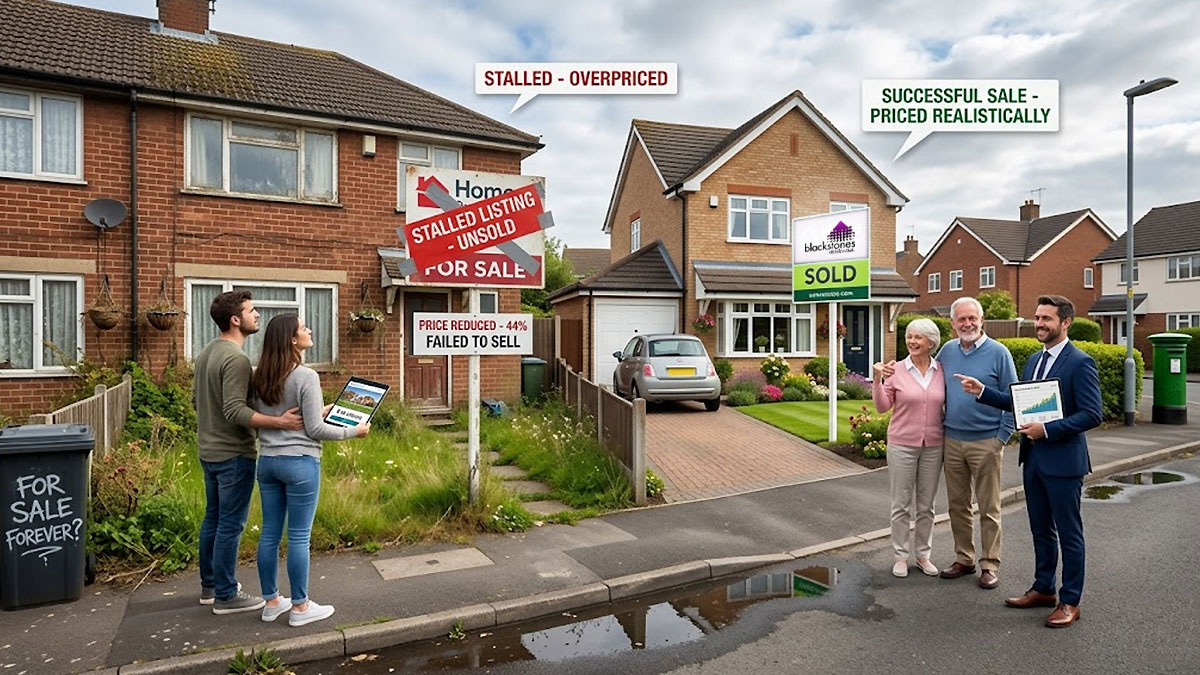
Stuck on the Market: Why 50% of UK Listings Stall (and How to Avoid It)
Landing a "Sold" sign in today’s real estate climate isn't as straightforward as it used to be. With roughly half of UK properties currently struggling to find a buyer, the dividing line between a stagnant listing and a successful closing comes down to sharp strategy. To keep your move on track, we look into exactly why so many homes are hitting a brick wall, alongside the proven adjustments top sellers are using to stand out and seal the deal.
Ever worried about taking the plunge and getting that ‘for sale’ sign up, only to find your home sits around and won’t sell?
It’s only natural to worry about what might happen once you’re on the market.
Our latest survey results show this worry isn’t unfounded, but you have more influence than you might think. In fact, successful sellers are doing a few key things differently to get a result.
Sellers admit they priced too high
We asked more than 2,000 UK adults who tried selling their home in the past 3 years if they’d been successful. Almost half (44%) said their home failed to sell.
Price is the biggest sticking point, with overconfidence directly damaging success. Of the sellers who failed to find a buyer, 16.2% knew their home was overpriced from the outset.
More than a third (34%) realised, with hindsight, they’d set an unrealistically high asking price. At the time, these sellers thought they were asking a ‘fair price’.
What successful sellers are doing differently
Pricing realistically to avoid later reductions
Many sellers are discovering the hard way how important realistic pricing is.
For 53% of sellers, reducing their asking price was the only way to attract a buyer. Those that did drop their price did so by an average of 7%.
Our data shows the average home sold for 3.5% below the asking price in the first 3 months of 2026. That’s equal to £18,000 below the original advertised figure.
Getting a valuation before any viewings
Approaching a move in the right order is pivotal to selling.
More than 6 in 10 sellers (61%) viewed other properties before getting their own home valued. Some 32% went as far as making an offer on a property before getting a valuation.
For 21%, their inflated asking price was based on the amount needed to buy a home they’d already found. Unsurprisingly, 21.7% looked back and said their sale failed because they couldn’t achieve the price required.
Pricing for the market - not their move
Age and the reason for moving is linked to sales success. Younger sellers are more likely to be trading up the ladder, creating financial pressure to set a price that is unachievable.
The main reason under-35s were trying to sell was to trade up to a larger property (44%), with every penny from their sale counting. Our survey found only 52% of under-35s sold their home successfully, compared to 63% of those aged 65+.
Among under-35s, 26% looked back and realised they’d priced their home too high and 20% knowingly overpriced from day one.
On the other hand, the experience of older movers is clear.
As well as better completion rates, people aged 65+ in our survey were less likely to overprice their home at the start (6%). And they were less likely to look back and regret an inflated asking price (12%).
With 34% of those aged 65+ downsizing, they’re more likely to be moving to a less expensive property. It’s also likely that these older homeowners have built up more equity in their current home, reducing the pressure to achieve a higher price.
Using an estate agent to guide their success
Most people get estate agents to value their home as their first step of selling, and there’s an important link between taking pricing guidance from estate agents and getting a successful sale result.
Of the most successful sellers - the 55+ age group - 83% heavily relied on an agent’s pricing advice.
Conversely, far fewer under-35s (53%) were influenced by estate agents. The youngest sellers also took advice from family and friends.
Adam Day, Head of eXp UK and Europe, reinforces the importance of local knowledge:
“The market moves at very different speeds from one street, town or postcode to the next. This is why working with an experienced local agent is important.
“They will price your property appropriately, based on genuine local demand. They’ll also identify your home’s unique selling points – the ones most likely to resonate with buyers in your area.”
Prioritising presentation and home maintenance
While the key takeaway for sellers is to price realistically using an estate agent’s advice, presentation matters.
Successful sales had one thing in common – appearance.
The home being sold was clean, the garden tidied and minor repairs had been made ahead of the sale.
Mark Manning, Managing Director at Northern Estate Agencies Group, says first impressions matter:
“If viewings aren’t leading to offers, think carefully about how your property is presented, both online and at the kerb. Act on feedback early as the sellers who struggle are almost always the ones who simply wait and hope something changes.”
Monitoring their home’s value and local market
With 38.6% of sellers using online sources to help price their property, accurate monitoring is also vital.
Track your home for a real-time snapshot of what your home might sell for and what's happening in your local market. Use this in tandem with estate agent valuations to get a realistic price for your property.
How your local market will influence your sale result
There’s one thing that’s less in your control when it comes to selling - and that’s the performance of your local market. Local levels of demand, supply and stock will influence your sale, even if you do everything right.
Monitoring your market long before you decide to sell is a great way to stay on top of this and price in line with buyer activity.
And speaking to a local estate agent is invaluable in uncovering the unique dynamics in your area, right down to your street.
Regions across the North of England have the highest sales success rates, with 3 out of 4 homes selling in Northern Ireland. More than two-thirds of sellers in Yorkshire and the Humber, the North East, the North West and Scotland successfully selling their home.
The market has been especially sluggish in London, where only 38% of properties listed for sale have reached completion. All other regions see at least half of all properties sell.
|
UK region |
Sales success rate |
|
Northern Ireland |
77% |
|
Yorkshire |
69% |
|
North East |
68% |
|
North West |
68% |
|
Scotland |
67% |
|
East Midlands |
65% |
|
South West |
60% |
|
Wales |
56% |
|
East England |
53% |
|
South East |
52% |
|
West Midlands |
50% |
|
London |
38% |
|
UK average |
56% |
Key takeaways
- 44% of UK homes listed for sale in the past 3 years failed to sell
- Overambitious and unrealistic pricing is the biggest reason homes remain unsold
- Under-35s are more likely to overprice in order to afford their next home
- Pricing in line with local property values improves the chances of selling

9 Smart Questions to Ask at Your Next Home Viewing
It’s easy to get caught up in the excitement of a home viewing and completely forget to ask the most important questions. But once you're inside, your time with the agent is the perfect opportunity to dig deeper. Here is a breakdown of the nine essential questions you should always ask on a viewing, complete with expert advice from estate agents to help you get the answers you actually need.
Finding out the right information saves time and helps you to work out what you really want. Remember, there’s no such thing as a silly question when it comes to property.
To help you on your way, our experienced agents reveal the most common questions they’ve been asked by first-time buyers.
1. What’s the area like?
Great transport links, green spaces, bars, restaurants and good schools are all top of the agenda when it comes to location. So this is the first question to put to an agent.
Be sure to carry out your own research, too. Walk around the neighbourhood in the daytime and after dark to get a feel for traffic, atmosphere and security.
Try out your commute from the area, check out the crime statistics and look into the pollution levels too.
All of this information will help you to work out if you're looking in the right place for you.
"There’s a lot of nuances to this as the obvious things like schools and transport links that may stand out can be offset by some things," says Christian Cudd, head of sales at Hamptons in Clapham and Battersea.
"A quiet street may not be all that quiet at on a Saturday night when the pubs kick out. Ask your agent about changes to the area coming up.
"There's an area in Battersea, for example, where prices have been going up and up because of access to the new Northern Line station.
"Walk around the area at night when things can feel very different!”
2. How long has the property been for sale?
Knowing how long a home has been on the market offers buyers some important clues on how to proceed when it comes to putting in an offer.
If it’s been on sale for a while, the seller might be prepared to accept a lower price.
If your estate agent is aware of any problems with the property – from structural issues to rowdy neighbours – they are legally obliged to tell you. So definitely ask!
“If a home hasn't sold there's likely to be a reason", says Colby Short, CEO of GetAgent.co.uk.
"It could be due to structural issues or other red flags. In any case, the agent has to give you a full rundown, so be sure to ask.
"If a property's been on the market for some time, the chances are the seller might accept a lower offer but don’t always assume so.
"In some cases, problems on the side of the buyer can cause the sale to fall through and bring the seller back to square one. If this is the case, the seller may be unlikely to adjust their price expectations.”
3. Why is the owner selling?
It might feel a bit nosy asking this question. But, don’t worry, many first-time buyers do.
They could be downsizing, upsizing, moving within a school catchment area or getting divorced.
Knowing the answer is likely to give you a better idea of the strength of your position.
“It may seem like an intrusive question but you’re well within your rights to ask and, if anything, it’s advisable to do so," says Alice Bullard, head of commercial at Nested.
"It’s always better to know in case the reason is a negative one. If it’s due to a problem neighbour, the fact the neighbourhood has declined or there’s a mobile telephone mast being erected in the garden, then alarm bells should be ringing.
"Of course, there’s no guarantee that the seller will be 100% honest about any negative influences, so it really is down to you to research thoroughly to avoid any nasty surprises.”
4. Is the broadband any good?
No self-respecting first-time buyer would be caught out by dodgy internet, which is why this question is among the most common put to our agents.
Keep your phone on during viewings, noting any weak spots as you walk around and check for phone coverage more generally, too.
Ask for details of their current broadband set-up, including the provider, speed and service.
"If there is a particular provider you want to use, contact them to make sure that they cover the area and can transfer your current service," says Cudd.
5. Are the coat hangers included in the sale?
Our estate agents have heard it all. And even though it sounds like a joke, the point stands: be 100% sure of what's included in the asking price.
After all, there’s no point falling for that cool home office pod in the garden if it isn’t staying.
"Items that are not bolted down or integrated, are not included in the sale price," says estate agent Chris Buckler of KW London Bridge.
"When you make an offer, be detailed and include anything extra you want in the email to your agent. I've seen sales fall through over a few hundred pounds on a hallway carpet.“
As a rule, boilers, radiators, fitted carpets and window coverings tend to be included in the sale. White goods such as washing machines and fridges are often up for negotiation.
"We’ve even seen examples where a thrifty seller has taken all of the lightbulbs with them," says James Forrester of Barrows and Forrester.
"Always ask what will and won’t be left with the house. It can avoid disappointment on moving day, but it can also work in your favour.
"Some sellers may be willing to leave certain items of furniture either as part of the deal or for a little extra on the asking price."
6. How do I make an offer?
While you may have found the home of your dreams, it's probably worth avoiding this question. Maybe play it a bit cooler?
The answer to ‘How do I make an offer?’ is: you will need to put the amount you are prepared to pay in writing (email is fine), and the estate agent will then put this to the seller.
As a first-time buyer, you're in a strong position to negotiate. You have nothing to sell and you're not in a chain. So don’t show your hand too early.
Instead, why not ask if there have been any other offers made on the property and for how much. While the estate agent may not disclose the full details of other offers, you might get a good hint.
Use this information to guide you when deciding what to offer.
"The estate agent is your guide through this and should help you all the way through, alongside your solicitor," says Cudd.
"Ask about other offers on the property, this may reveal how flexible the pricing is and what you could potentially negotiate."
7. Can I speak to the seller directly?
You may meet and chat to the owner during a viewing. But the agent's job is to broker the deal between you and the seller.
Once an offer is accepted, you may be able to swap details with the seller if they agree, so you can communicate if needed.
But mostly, any communication over the sale will be between you, your estate agents and your solicitors.
“Communicating with the seller is largely restricted, especially during the negotiation and offer stage, and there’s good reason," says Marc von Grundherr of Benham and Reeves.
"It’s our job to negotiate and advise a seller on their best options and they can sometimes be stubborn when it comes to dropping their asking price.
"An anxious or over-enthusiastic first-time buyer can also hinder the process by over-communicating.
"Hitting the seller with a constant barrage isn’t advisable when they’re going through one of the most stressful processes in life. In fact, it can put them off selling to you.”
8. Do I really need to pay for a full survey?
Although they hear this question a lot, the estate agent can’t answer it on your behalf.
Having a survey is not a legal requirement but, as you are about to make a huge financial commitment, it’s a very good idea.
There are three levels of survey to choose from. But a mortgage lender's ‘valuation survey’ is not one of them. This only confirms the property is worth what you have agreed to pay for it.
New-build homes could be an exception as they are covered by a 10-year NHBC guarantee, although it may still be worth getting a ‘snagging survey' done.
Find out about the options for surveys here.
“Better safe than sorry in most cases!" says Cudd. "The only exceptions is with new builds built within the last 10 years, as everything will generally be under warranty.
"Your valuation survey from the bank is ‘skin deep’ so may not raise anything that needs attention straight away. Better to swallow the cost of a home buyers survey than find something nasty a few days after moving in!”
9. Can I bring my pet?
Not as odd a question as it sounds. Don’t assume that, just because you're buying a home, you'll be able to bring your pet with you.
If you are buying the freehold to a property, then of course you can keep animals.
But if you're buying a leasehold home, there may be covenants within the lease that prevent you from keeping certain types of pets.
Make sure your solicitor checks the terms of the lease thoroughly.
"Never assume!" says Cudd. "Some leasehold properties prohibit pets and this could end up in a sticky situation if you haven’t checked.
"Freehold houses are generally free and clear of any restrictions like this."
Key takeaways
- Find out what the local area is like, how long the property has been on the market and why the owner is selling
- Check the broadband speeds for the property and what will be included in the sale. Will the washing machine be staying?
- Find out what other homes in the area have sold for before making your offer